
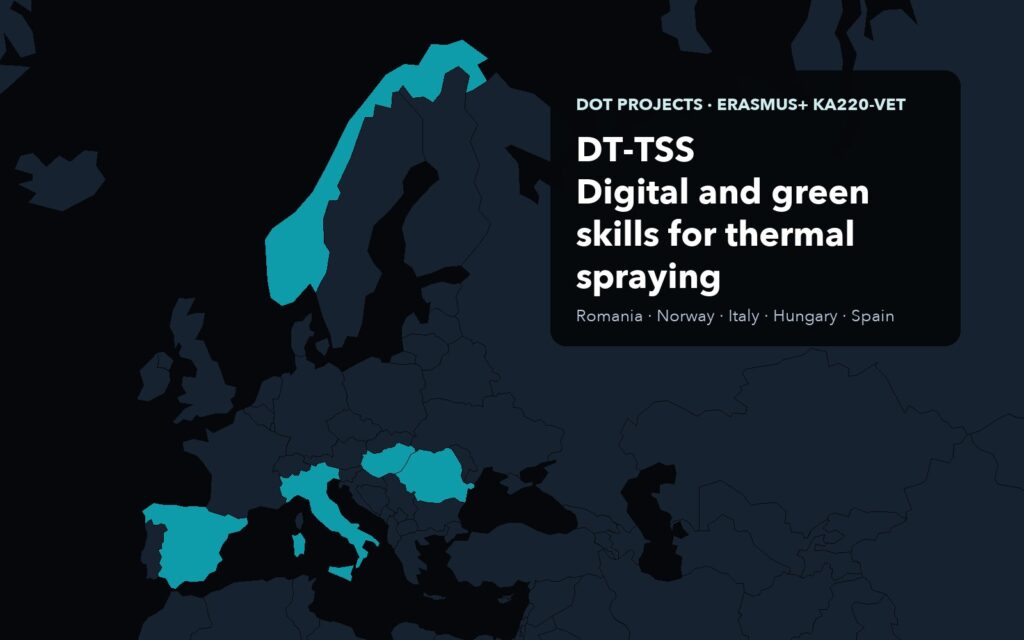
I-STEP member DOT Projects has joined DT-TSS, a new Erasmus+ vocational training partnership that brings digital and green skills to industrial thermal spraying, and will lead its dissemination.
DOT Projects has joined DT-TSS – Digital Training for European Thermal Spraying Specialists, an Erasmus+ cooperation partnership in vocational education and training (KA220-VET) that runs from 1 September 2026 to 31 August 2028.
It is a different field from the youth work DOT is best known for, and that is part of the point: the project needs people who can make technical results clear, usable and open to everyone.
Who is in the partnership
DT-TSS is led by ISIM Timișoara, the National R&D Institute for Welding and Material Testing (Romania). The partners are Quality Management Software AS (Norway), Consorzio CALEF (Italy), the University of Miskolc (Hungary) and DOT Projects (Spain).
What it sets out to do
Industrial thermal spraying is a specialist technique used to coat and repair components. DT-TSS aims to make training in it more sustainable and more inclusive, with less waste and better use of resources. Over two years the partners will:
- update the European guideline for thermal spraying specialists, in line with international standards;
- develop course materials and interactive e-learning modules, including an ECVET-compliant training guide;
- train vocational teachers in digital and green skills, in cooperation with industry and research partners;
- hold national dissemination workshops and write a sustainability plan so the results enter VET curricula.
DOT’s role
DOT Projects leads the dissemination work package and the national workshop in Spain, where the digital curriculum will be presented to vocational schools and industry. It also brings what it knows best to a technical consortium of research institutes, a university and a software company: inclusion, stakeholder engagement and usability.
For DOT, DT-TSS opens a new field for its European work while keeping the same question at the centre: how to make learning more accessible to the people who need it.
Co-funded by the European Union. Views and opinions expressed are those of the authors only and do not necessarily reflect those of the European Union or the European Education and Culture Executive Agency (EACEA).
This story was first published by DOT Projects on its own website: read the original on dotprojects.es.