
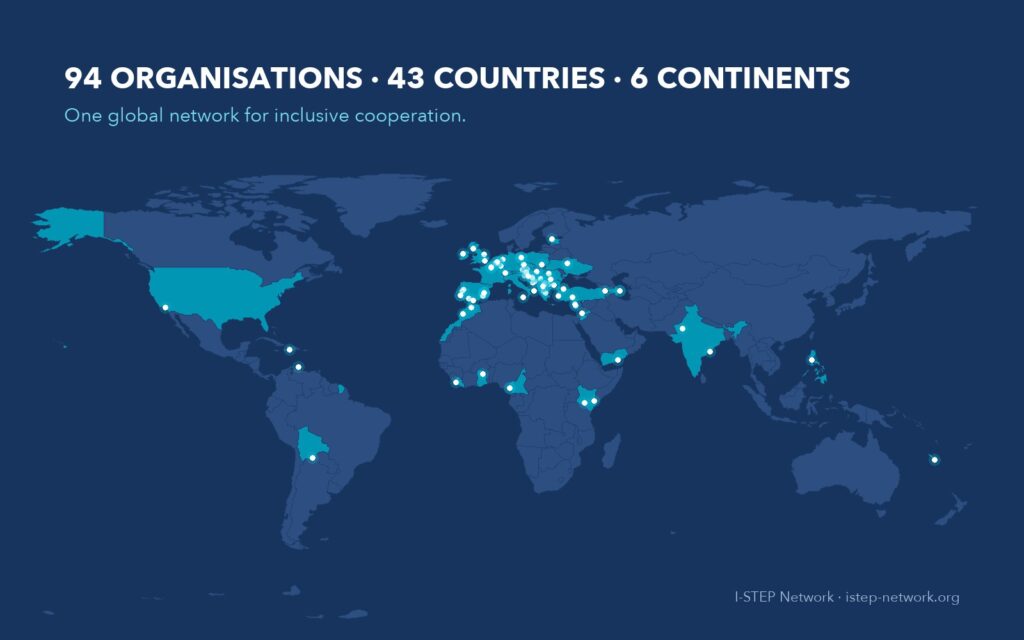
There are moments when growth stops being just a number. For I-STEP Network, this is one of them.
In a short time, I-STEP has reached a milestone that changes the scale of the network: our members are now present on all six inhabited continents. From Europe to Africa, Asia, North America, South America and Oceania, organisations working in very different communities are connected through one network and a shared commitment to making skills, training, employability and participation more inclusive.
I-STEP in numbers
As of 6 October 2026, the network brings together:
- 94 member organisations
- 43 countries
- 6 continents
- 39,443 paid staff and 5,278 active volunteers
- 2,494,324 people reached directly every year
- 27,077,737 people reached indirectly every year
The figures are real and we are proud of them. But they are not the story on their own. The story is what becomes possible when organisations that geography, sector and context would normally keep apart start to find one another.
One network, very different realities
An organisation working with young people in Europe may have more in common than expected with one supporting communities in Africa. A disability organisation in Asia may hold methods that are immediately useful to a training provider in Europe. A youth organisation in Latin America may change how a European consortium thinks about participation. A community organisation in Oceania may open forms of international cooperation that many members have never tried.
That is what geographical diversity is for. Being present on six continents is not about putting more countries on a map. It is about creating more chances for knowledge, methods, experience and partnerships to travel between contexts, which is why I-STEP was created.
Practical cooperation, not a directory
I-STEP is not meant to be a list of organisations. Membership should make it easier to do things together.
Members work in education, youth, disability, employment, digital inclusion, democracy, participation, sustainability, training, social innovation and community development. Their models are just as varied: grassroots NGOs and youth organisations, universities, SMEs, public bodies and large civil-society organisations.
That mix is a rare pool of expertise. A consortium looking for experience in inclusive employability can find organisations that work directly with the people concerned. A member developing a new training methodology can find partners in other countries to test or adapt it. An organisation entering international cooperation for the first time can connect with members that already know European programmes. And organisations looking beyond their usual networks can start to find partners in entirely new regions.
Almost 45,000 people behind the network
Networks tend to be described through organisations and countries, but organisations are made of people. Across the current membership, 39,443 paid professionals and 5,278 active volunteers keep the work going: almost 45,000 people. Together they reach almost 2.5 million people directly each year, and more than 27 million once wider communities and indirect audiences are counted.
That collective capacity matters. A methodology can be tested in several countries. A practical resource can reach practitioners in many sectors. A local approach that works can join an international conversation. And the results of a project can keep circulating through a network long after the project itself has ended.
Growing is not enough
Becoming larger is not I-STEP’s objective. The next challenge is more important: turning geographical reach into useful cooperation.
That means helping members discover one another, making organisational expertise easier to find, cutting the friction of looking for partners and building international collaborations, sharing opportunities and resources, and helping relationships formed in the network grow into projects, exchanges, methodologies, research and training. I-STEP is building that practical infrastructure for its members alongside the growth of the community.
The goal is not to be the network with the longest membership list. It is to be a network in which membership genuinely helps organisations collaborate better.
Six continents, one shared idea
I-STEP’s members work in different languages, legal systems, sectors and communities, at different scales and with different histories. What they share is the conviction that more inclusive societies are built when organisations are willing to learn from one another and work together. Today that collaboration stretches across six continents, and we are only getting started.
Join the network
I-STEP membership is free and open to organisations whose work fits the network’s mission and collaborative approach. Applications are reviewed by the I-STEP Board.