
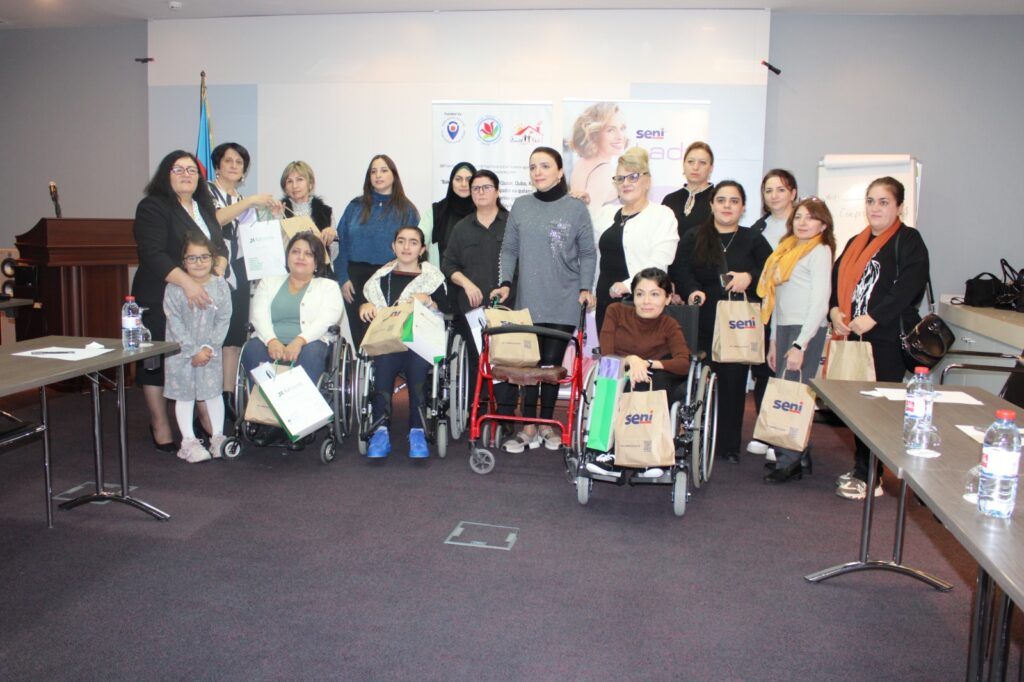
The Disabled Women’s Society continues to strengthen international cooperation to advance the rights, inclusion and participation of persons with disabilities, with a particular focus on women and girls with disabilities.
Our work is guided by the UN Convention on the Rights of Persons with Disabilities (CRPD) and the Sustainable Development Goals (SDGs), particularly SDG 5 on gender equality, SDG 8 on decent work and economic participation, SDG 10 on reduced inequalities, and SDG 17 on partnerships.
We promote inclusive skills development, training, employability and digital inclusion, while advocating for accessibility and the application of Universal Design principles in public services and community life. Since 2019, the Disabled Women’s Society has held consultative status with the UN Economic and Social Council (ECOSOC), providing an important platform for international cooperation, knowledge sharing and advocacy.
Listening to the experiences of refugee women and girls with disabilities
One of our important projects, “Life Stories of Refugee Women with Disabilities”, focused on documenting the lived experiences of refugee women and girls with disabilities and creating a safe and respectful space for them to speak about their lives.
The project highlighted an important reality: for refugee women and girls with disabilities, accessibility is not limited to physical access to buildings or public spaces. It affects almost every aspect of daily life and can determine whether a woman is able to live independently, access services, communicate her needs and participate fully in society.
What did the women tell us about accessibility?
Through the interviews, women spoke about a range of practical barriers that can become particularly serious for people with disabilities.
Access to assistive devices was one important concern. When a person loses access to an assistive device or cannot replace or repair it, everyday independence can be significantly affected. Access to healthcare, rehabilitation and appropriate support services was also identified as important.
Housing was another major issue. For women with disabilities, having a safe home is not enough if the environment cannot be adapted to their individual needs. Accessible entrances, bathrooms, mobility within the home and other elements of Universal Design can make the difference between dependence and independence.
The women also highlighted the importance of access to social protection, documentation, information and public services. For a woman with a disability, a service may technically exist but remain inaccessible because of physical, communication, informational or administrative barriers.
These testimonies reinforced our understanding that accessibility must be approached holistically. It includes the built environment, transportation, information and communication, digital services, healthcare, rehabilitation, social protection, employment and participation in community life.
What did the project produce?
The central outcome of the project was a documentary based on the personal stories and testimonies of refugee women and girls with disabilities.
The documentary serves not only as a record of personal experiences, but also as an awareness-raising and advocacy tool. It gives visibility to experiences that are often insufficiently represented in discussions about displacement, gender and disability.
The project also generated practical knowledge for our organisation about how to document the experiences of women with disabilities in a respectful, accessible and participant-centred way.
An important lesson was that women should not simply be interviewed as subjects of a project. They should be treated as active participants whose experiences and perspectives help shape the understanding of the issues being documented.
We believe that the documentary and the experience gained through the project can be further developed into a resource for organisations working on disability inclusion, gender equality, accessibility and the rights of refugee women and girls with disabilities.
Sharing the experience internationally
The documentary was presented to audiences in Norway and Sweden, providing opportunities to introduce the experiences of refugee women and girls with disabilities to international audiences.
The presentations created space for discussion about accessibility, inclusion, women's rights and the specific barriers experienced by women with disabilities. The interest generated around the stories demonstrated the importance of bringing the voices of women with disabilities directly into international conversations.
For us, international presentation is not only about sharing the final product. It is also about creating dialogue, exchanging experiences and learning from organisations working in different contexts.
What can other organisations learn from our experience?
Our experience offers several lessons that may be useful to other organisations.
First, projects involving women with disabilities should begin with listening to their own experiences and identifying the barriers that they consider most important.
Second, accessibility should be considered throughout the entire process — from identifying participants and arranging interviews to communication, documentation, dissemination and participation in public events.
Third, organisations should create a safe and respectful environment in which women can decide how they wish to share their experiences and what aspects of their lives they are comfortable discussing.
Finally, documenting personal stories should lead beyond awareness. The evidence and experiences collected should contribute to better policies, more accessible services and practical recommendations for inclusion.
The project has strengthened our conviction that refugee women and girls with disabilities must be recognised not only as people who need support, but as rights-holders, active participants and contributors to more inclusive societies.
Continuing international cooperation
The Disabled Women’s Society will continue to build partnerships with organisations working to advance inclusive skills, training, employability, digital inclusion, accessibility and the rights of women and girls with disabilities.
We believe that sharing practical experiences across countries can help organisations learn from one another and develop stronger approaches to inclusion.
Our experience with “Life Stories of Refugee Women with Disabilities” has shown us once again that when women with disabilities are given the opportunity to speak, their experiences can inform not only public awareness, but also the way organisations understand accessibility, design services and advocate for lasting change.
We look forward to continuing this exchange within the I-STEP network and contributing our experience to a stronger international community working towards inclusive development where no woman or girl with a disability is left behind.